

Spoilt Climate Cult
The psychology of antisocial attention-seeking.

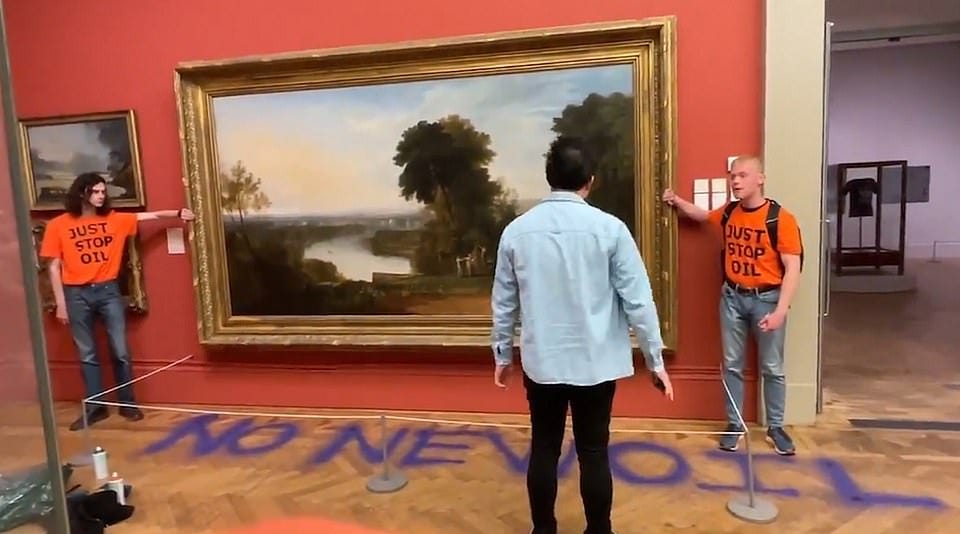
Guest Post by Harrison Koehli of Political Ponerology Substack.
You’ve seen them in the news. Young, often crusty-looking climate activists defacing priceless works of art, gluing their hands to museum walls, and screeching. Their stated motivation isn’t important. But the reason they give is “because oil.”
The first such stunt to catch my attention was this one, back in October:
Climate activists target art: Van Gogh’s masterpiece 'Sunflowers' defaced
Thankfully the people who run museums are not stupid or careless, and glass coverings protect the paintings. Only the frame was slightly damaged in this case, and the two miscreants—members of the UK activist group “Just Stop Oil”—were arrested.
This wasn’t JSO’s first such stunt. In June, a pair of them glued their hands to another van Gogh. In July, to a John Constable and a copy of Leonardo’s Last Supper. After the Sunflowers, they did the same to Vermeer’s Girl With a Pearl Earring. A like-minded German group decided a Claude Monet needed a smattering of mashed potatoes before gluing themselves to the wall.
Last week another such group, “Last Generation,” doused Gustav Klimt’s Death and Life with black liquid in Vienna, and another, “Last Reform,” performed similar acts in Paris. These groups also enjoy gluing themselves to the pavement and causing traffic jams that block emergency vehicles.
Why did I say their stated motivations aren’t important? Because these groups aren’t interested in changing anyone’s mind. These kinds of public tantrums only have the effect of discrediting their own cause—which I think is the point. Making people late for work does not endear them to you or your cause. You just piss them off. Defacing beloved works of art—the symbols of the achievements of our civilization—offends regular people.
If anything, these acts of antisociality will not only fail at bringing them any popular support; they will make people even more hostile to them and their message.
But they’re not stupid. They just see the world in a very different manner than the rest of us. Their “protests” are actually carefully calibrated displays of public destruction—just enough to get media attention, but not enough to actually permanently damage these works of art. Rather than throw paint on a display of a car painted by Warhol, for example, they simply dusted it with flour. This is akin to Antifa’s “calibrated level of violence”—just enough to get away with it.
I’m Canadian so I know a lot of liberals, to understate the matter. But here’s the thing about liberals: they tend to love art. I can’t think of anyone I know personally who would even take the chance of damaging a national treasure such as those targeted by these activist groups. That tells me something. The people engaged in these acts of defacement don’t care about art or beauty—just look at their personal appearance. And they don’t feel any real sense of social duty or responsibility, let alone shame or guilt. Their concern about climate change is merely the expression of something more fundamental to their character. It’s an outlet for their own personal psychopathology.
Harold D. Lasswell laid out the dynamic back in 1930, and it still broadly holds true today. The activism of political agitators can be traced back to their own private motives, those motives’ displacement onto public objects, and their rationalization in terms of public interests. As for their craving for mass responses: “Agitators as a class are strongly narcissistic types.” They are simply taking out their own resentments, hatreds, and revenge fantasies on the world at large. Their political activism is akin to functional mental disorders, which, per Lasswell, “…are efforts at adjustment which fail.”
With that in mind, take another look at the dynamics here. These groups have a message, they calibrate their stunts to get the maximum level of media coverage, but the means of getting across that message turns people off from that message. So what is the purpose? They may believe they can get a mass response—in which case their activism is more of a delusional system than a political program. But because it is rooted in their own personal psychopathology, it is, as Lasswell wrote, an effort at adjustment that is designed to fail.
They’re sending out a message, but it’s not primarily intended for you or me. They are recruiting. (Again, perhaps with the delusional belief that there are more people out there like them than actually exist.) But the only people who will respond positively are those with a similar psychology: alienated, resentful, destructive, paranoid, narcissistic, and potentially psychopathic.
In case it isn’t apparent, this was the same strategy used by ISIS with their despicable destruction of ancient sites and artifacts. JSO might not have progressed to that level—because they can’t at this point—but the underlying psychology is the same, and they wouldn’t hesitate to do so if they were in a position to get away with it. When they do will be a turning point and not a pleasant one.
Underlying these dynamics is also a particular view of power. It is not one based on persuasion, common sense, or decency. Rather, it is a view based on psychological terror and coercion—one of the core features of pathocracies. Their tactics are basically those of a hostage taker or someone calling in bomb threats to airlines—not known to be the most psychologically stable of people.
The best framework for understanding all this remains Andrew Lobaczewski’s Political Ponerology. This is what it all comes down to:
In a civilization deficient in psychological knowledge, hyperactive individuals driven by an inner angst caused by a feeling of being different easily find a ready echo in other people’s insufficiently developed consciousness. Such individuals dream of imposing their power and their different experiential manner upon their environment and their society. Unfortunately, in a psychologically ignorant society, their dreams to impose on societies their own, different way of experiencing and conceptualizing, and then, their power, still stand a chance of being accomplished. (p. 13)
Such individuals’ comprehension of social and moral questions is different, both from the natural and from the objective viewpoint; they constitute a destructive factor for the development of society’s psychological concepts, social structure, and interpersonal bonds. (p. 47)
Many such people attempt to impart meaning to their deviant lives by means of social hyperactivity. They create their own myths and overcompensatory ideologies and have the tendency to egotistically insinuate them to others. Their goals and ideas, which result from their deviant manner of experiencing, easily hook into minds in which the sense and understanding of psychological realities has already started to deteriorate. (p. 58)
Climate activism is rooted in another myth with a hysterical overcompensatory ideology. The content of the ideology is not important—only the inner dynamics. Michael Shellenberger and Peter Boghossian have compiled a handy PDF of these ideologies and their core features. Consider these the delusional systems concocted for private motives, but displaced onto public objects in the service of ostensibly public interests.
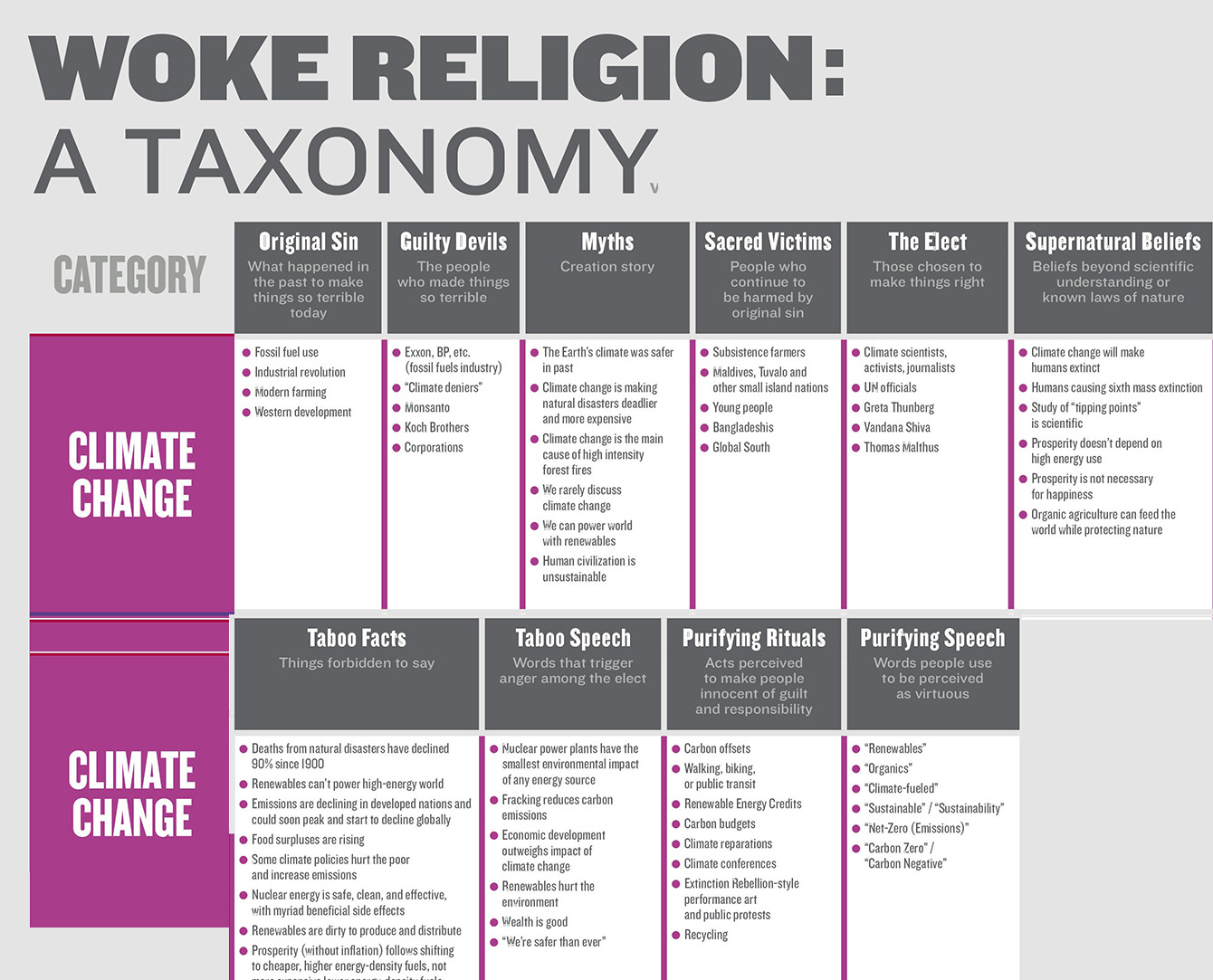
Whatever the flavor of Woke—whether it concerns climate change, racism, trans, crime, mental illness, drugs, or homelessness—each has the structure of what I call an anti-religion. For each of these varieties, Shellenberger and Boghossian list their forms of original sin, guilty devils, myths (creation stories), sacred victims, the elect, supernatural beliefs, taboo facts, taboo speech, purifying rituals, and purifying speech.
In the case of climate change activism, there’s naturally a sense of the apocalyptic. Fossil fuels and global industry have created a system that threatens mass extinction, and we must deface works of art and glue ourselves to museum walls—in addition to reducing our “carbon footprints,” paying carbon taxes, and going green—in order to stave off the wrath of the sun god. We only have x years left. Just don’t say nuclear.
The structure of this belief system bears more than a passing resemblance to the paranoid prophets of old, like Thomas Müntzer, or a more modern one like Jim Jones. Just as with their explicit beliefs, it doesn’t matter that the apocalypse never comes—with the types of folks creating these movements, they always bring their own apocalypse.
Take a brief look at Just Stop Oil’s guru and founder, Roger Hallam, who also founded Extinction Rebellion. And since we probably live in a simulation, his groups are funded by Getty Oil heiress Aileen Getty:

With ponerology in mind, his “warning” takes on a slightly different quality. If there’s one thing that’s clear from history it’s that this sort of collapse is not the type of thing prevented by groups like JSO and ER. They’re the ones who cause it.
It shouldn’t come as a surprise if someday these groups become even more terroristic in their methods. They’ve convinced themselves that the fate of the planet depends on them. And the more they fail, the harder they’ll have to try—not realizing that their failure was predetermined, because their ideology is not at all based in reality, and not even rooted as a primary motivation.
The world will never please them. It will never fill the inadequacies they feel inside, the lack of connection to the lives of others. Their ideologies are designed to be unfulfillable. This debt can never be repaid, which locks them into a never-ending cycle of criticism and protest. Any concessions and “positive change” in the world will never be enough. It cannot be, because the compensatory myths are designed in such a way as to reflect the inner psychology of those creating and espousing them.
Groups like JSO won’t get much traction with regular people. They can’t, by their very nature. But that doesn’t mean the ideology itself won’t. It obviously has. And unfortunately, as long as our managerial overlords continue to pretend to buy into the climate lies, we will all be forced to continue to engage in the types of self-destructive idiocy that characterize “green” policies. Their impossible approaches are based on fundamental (perhaps intentional) misunderstandings of economics, natural resources, science, and reality, yet are powerful tools of mass destruction in the hands of pathocrats.
Subscribe to Political Ponerology
By Harrison Koehli
Pathopolitics, psychopathy, and mass hysteria.

Thanks for sharing.
Visit shop.thegoodcitizen.live


Donate
BTC: bc1qchkg507t0qtg27fuccgmrfnau9s3nk4kvgkwk0
LTC: LgQVM7su3dXPCpHLMsARzvVXmky1PMeDwY
XLM: GDC347O6EWCMP7N5ISSXYEL54Z7PNQZYNBQ7RVMJMFMAVT6HUNSVIP64
DASH: XtxYWFuUKPbz6eQbpQNP8As6Uxm968R9nu
XMR: 42ESfh5mdZ5f5vryjRjRzkEYWVnY7uGaaD
Reading this article I couldn't help but think it was describing most politicians, apart from defacing art.
The world will never please them. It will never fill the inadequacies they feel inside, the lack of connection to the lives of others.
Such individuals dream of imposing their power and their different experiential manner upon their environment and their society.
This current art defacement does not make sense. The man on the right has a backpack. Any major gallery is checking for liquids and more at the entrance. If I recall, backpacks are not allowed in. These galleries also have cameras everywhere. How do these people get in? And how are they not stopped after the first spritz of spray paint? Surely other patrons are apt to yell when the spraying and splashing begins.